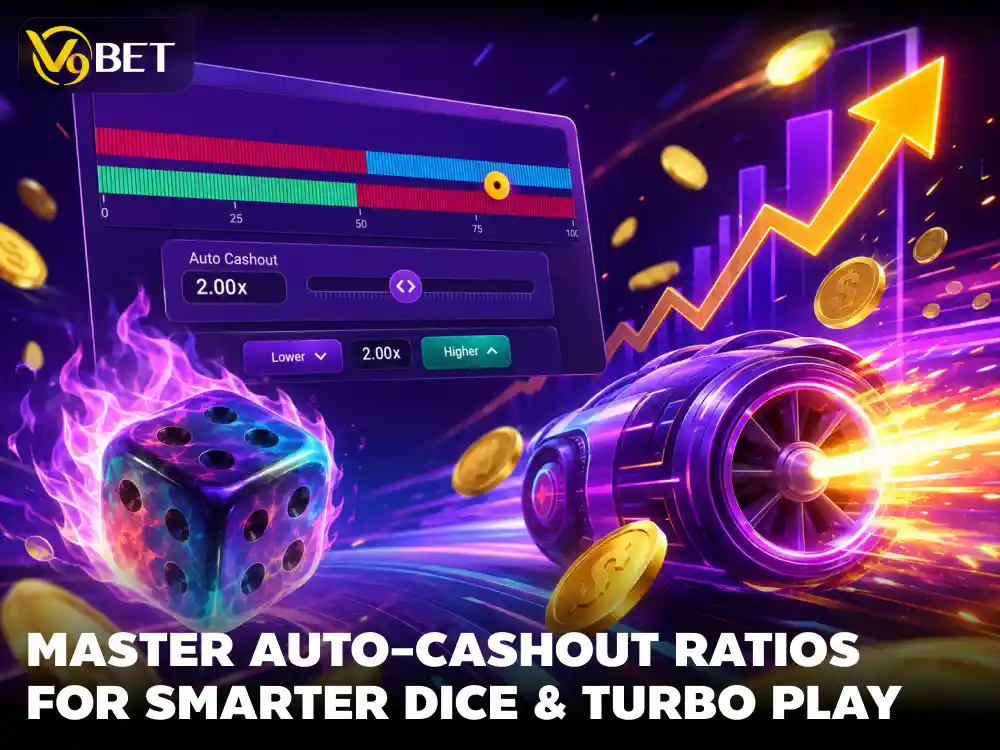
Unlocking the Strategy: Auto Cashout in Dice Turbo – Finding the Right Timing for Profitable Returns
Turbo games aren't just about speed—many of them let players set their own risk and reward levels. The dice game pictured is a clear example, because the screen isn't cluttered with reels or symbols. Instead, you see numbers from 0–100, a dividing line, payout multipliers, and win probability percentages—all directly connected.
What's interesting is that players don't just pick "high" or "low" and wait—you can adjust the target level to change both your winning chance and payout. The easier you make the condition to hit, the lower the payout per round. Conversely, choosing a harder-to-hit level pushes the multiplier higher, but with increased risk.
This is where the Auto Cashout function becomes relevant. Instead of treating the game as "pick a side and hope", you can start from the return you want, then work backwards to see whether the probability required fits your bankroll.
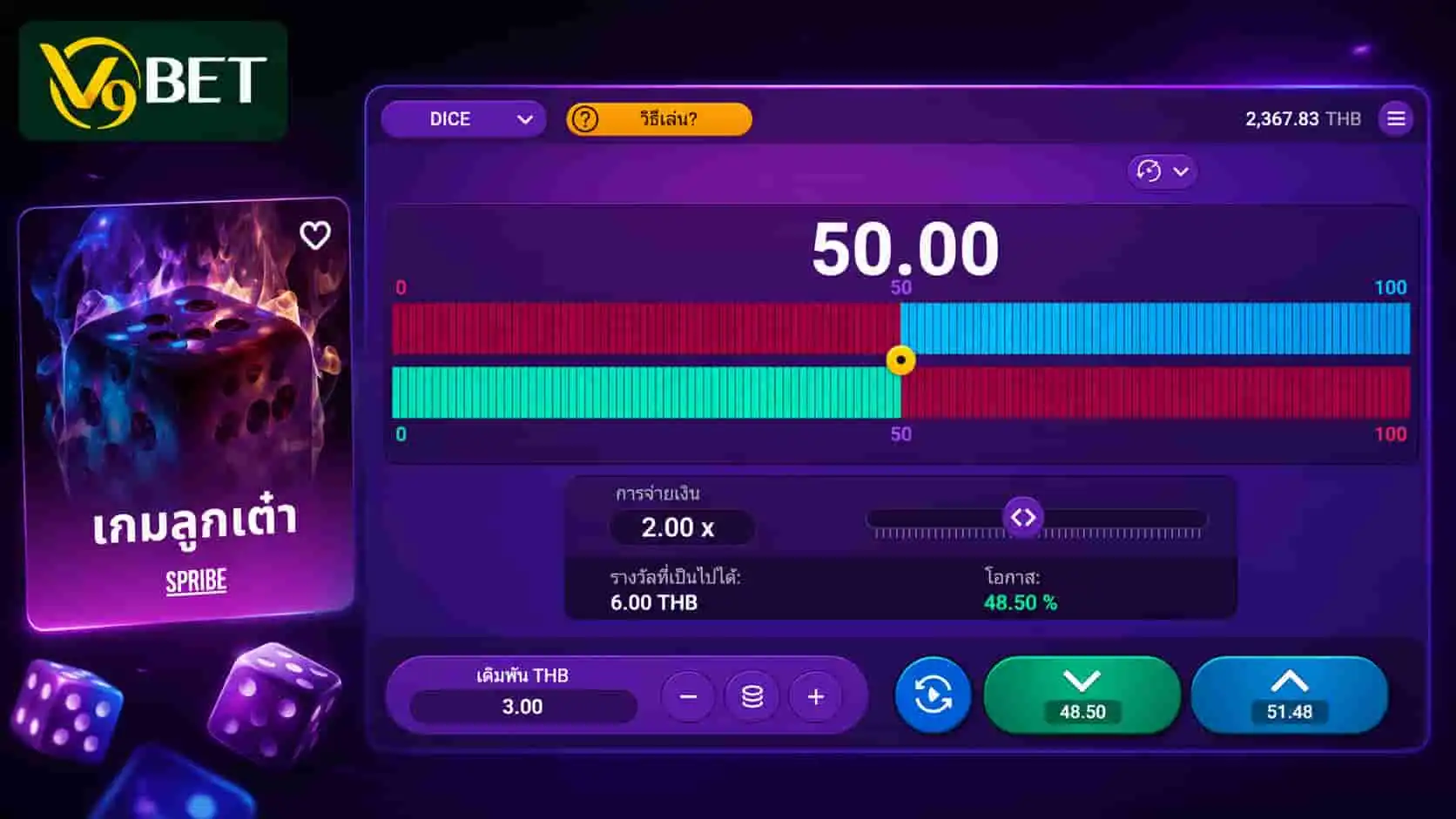
In the example shown, the bet is 3 Baht, the payout is 2.00x, and the win probability is about 48.50%. If the result meets the condition, the displayed reward is 6 Baht. This picture explains the core of the game well: the multiplier and win probability are not separate from each other.
This article will not try to find magic numbers or a guaranteed winning formula—because this type of game has uncertainty in every round. Instead, it focuses on how to read the screen, set profit targets, and use the game's tools in relation to your bankroll, so that players entering the dice game via V9Bet understand what risk level they are choosing before clicking play.
How to Play Dice Turbo: Understanding High/Low Before Betting Real Money
The dice game in the Turbo category has a fairly straightforward principle. Players set their bet amount, then choose whether they believe the round's result will be lower or higher than a target value on the 0–100 scale. The game shows key data—both payout and win percentage—before the round starts.
In the example image, the dividing line is near 50, with options for "below 48.50" and "above 51.48", showing roughly 48.50% chance and 2.00x payout. If you bet 3 Baht and win, the total return shown is 6 Baht. This is an example of choosing a roughly 50/50 risk level—but that does not mean results will alternate or be evenly split in each round.
The difference from games with fixed options is that the dice game allows you to adjust the dividing point. If you slide the line to cover a wider range of numbers in your favour, your win probability increases, but the multiplier decreases. Conversely, narrowing the target range lowers your success rate but raises the payout.
So before playing via V9Bet, you should look at three values together: bet amount, multiplier, and win probability. Do not choose based on the multiplier alone—a 5x or 10x number may look attractive, but you must also see how much you are lowering your chance of success.
That is why the dice game appears simple but offers more room for planning than it seems. You cannot control the dice outcome, but you can control how much money you risk, against what probability, and what return you aim for per round.
Dice games, specifically the Turbo game category, are another game you should try
How Auto Cashout Connects Multiplier and Win Probability in Dice Games
The core of Auto Cashout in this context is to help you preset a reward level or condition in advance. Instead of adjusting numbers aimlessly, you can start from an acceptable multiplier and see what win percentage the system reflects back.
The simplest example is the image with a 2.00x payout. If you bet 3 Baht, the winning return is 6 Baht—but the trade-off is that the success probability is not 70–80%, but around 48.50%, because higher returns come with higher risk.
If you lower your target (e.g., want a smaller multiplier), the winning range widens, increasing the success percentage but reducing profit per round. Conversely, if you push for a very high multiplier, the winning zone narrows, and you must accept that losing rounds will happen more often.
Therefore, using this function rationally is not about asking "which multiplier makes it easy to win", but rather "if I want this level of return, can I accept this level of success probability?" When you shift to that mindset, all the numbers on the screen become more meaningful for decision-making.
Setting Auto Cashout Based on Profit Goals, Not Chasing the Maximum Multiplier Every Round
One common mistake in turbo games is seeing a high multiplier and assuming it is more worthwhile—but "worthwhile" must always be considered alongside probability. If an option pays more but has a much lower success rate, the attractive-looking return may not suit everyone's plan.
Suppose you start with 300 Baht and set a bet of 3 Baht per round. Choosing a certain multiplier level will affect your bankroll volatility. If you pick a condition with a relatively high win chance, each win gives a smaller return, but your bankroll may move less violently than if you chose a high multiplier. Conversely, if you target several times your bet, one winning round can boost your balance noticeably, but a losing streak will also have a bigger impact on your remaining funds.
Using Auto Cashout should start with a clear goal—for example, you want short rounds with modest returns, or you can accept more volatility for higher multipliers. With a clear framework, adjusting the game level will not be a random emotional reaction after each round.
Another key point: do not change your target just because you lost the previous round—such as starting at 2x, losing, then increasing your bet and pushing the multiplier higher to chase losses. This increases both stake and risk simultaneously, which can deplete your bankroll faster than expected, especially in fast-paced turbo games.
When playing via V9Bet, setting a per-round bet that is a small fraction of your bankroll and defining a target return beforehand is a more controllable approach. Playing this game systematically does not mean predicting every outcome correctly—it means knowing in advance how much you are willing to risk and when to stop.
2x, 3x, or Higher Multipliers – Which Suits Your Bankroll?
There is no single multiplier that suits every player, because each level trades return for win probability. What you should consider is not just "how many times my bet", but also how many losing rounds your bankroll can withstand.
If you bet 3 Baht, a 2x multiplier means a total return of 6 Baht when you win. A higher multiplier gives a larger payout, but the winning condition becomes harder according to the game's mechanics. So seeing a reward of 9 or 15 Baht must be read alongside the decreased percentage—not as an isolated number.
Players who want to play many rounds may prefer a low per-round bet without pushing the multiplier to the extreme. Those who can tolerate more volatility may choose higher risk—but regardless of choice, setting a bet limit and a stop-loss before starting is still the most important step.
This is the appeal of the dice game on V9Bet: you can see the relationship between bet amount, payout, and probability right on the screen, so you don't have to rely solely on instinct—you can set conditions that match your actual bankroll.
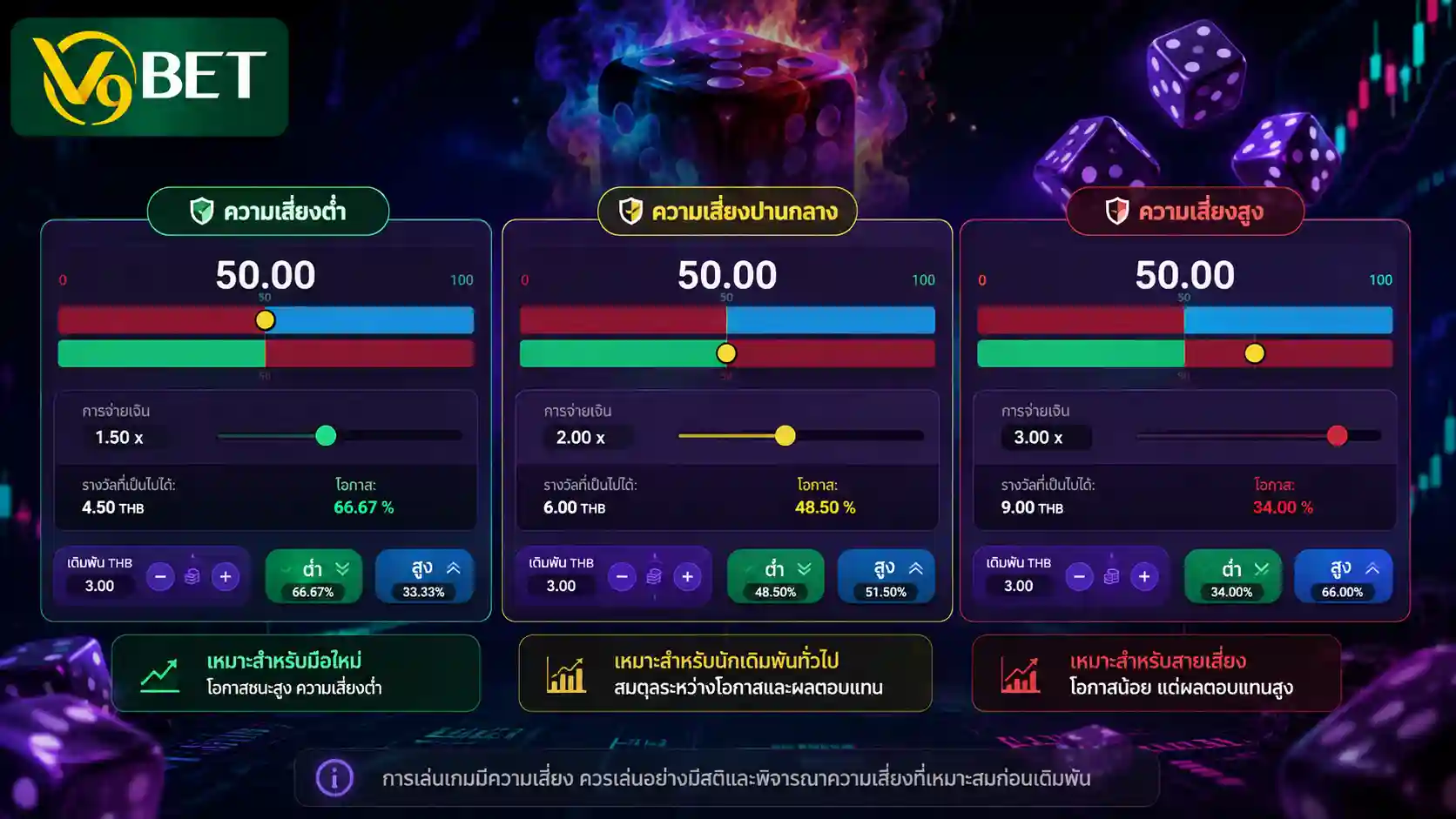
It's a game where you can choose the multiplier based on the level
How to Manage Your Bankroll in Dice Games When Speed Makes It Easy to Make Mistakes
The tricky part of dice games is not the complexity of the rules—the gameplay is actually easy to grasp—but the speed of each round can quickly throw off your plan. When results come fast, the next bet follows fast, and small bet amounts can accumulate into larger totals without you noticing.
The simplest management method is to set aside a specific session bankroll separate from your total account balance. For example, if you have 1,000 Baht in your account, you don't need to use all of it for dice. You might allocate just 200–300 Baht and keep the per-round bet low. Stop when that session ends, rather than continuously topping up from the remaining balance.
In the example image, a 3 Baht bet may seem small, but if you play 50 rounds, the total staked becomes 150 Baht—and if you increase to 10 or 20 Baht after each loss, the total can grow much faster. This point is more important than trying to guess the next number.
Another useful rule is to set a "profit target" and a "maximum loss" before you start. Suppose you set aside 300 Baht—you might decide in advance to stop when your balance reaches a satisfactory level, or if you lose up to a certain amount, end the session. This removes the need to make emotional decisions, especially after a few losses in a row.
When playing through V9Bet, always watch three numbers together: bet amount, multiplier, and your remaining balance—because even if you set the right risk level, increasing the per-round bet without a framework will still cause high volatility.
Most importantly, do not treat the previous round's result as a reason that the next round "must" go the other way. Several highs in a row do not guarantee the next will be low, and consecutive losses do not increase your chance of winning the next round. Bankroll planning should be based on the amount you are willing to risk, not on chasing past results.
Read more: Late August EPL Score Predictor Challenge – Win Free Bets Easily at V9Bet
Using Auto Cashout with a Betting Plan: How to Keep Risk from Spiking with the Multiplier
Once you understand bankroll management, the next step is to pair your bet size with Auto Cashout appropriately—because risk does not come only from the multiplier, but also from combining a "high bet" with a "low win probability" simultaneously.
For example, if you set a relatively high multiplier, lowering your per-round bet can help limit the impact when the condition fails. Conversely, if you choose a modest multiplier with a wider winning zone, you still should not increase your bet without limits, because a higher win percentage does not mean losing streaks won't happen.
You could split risk into three simple levels: low risk (small per-round bet, not chasing high multipliers), medium risk (balanced return vs probability), and high risk (accepting lower success probability for higher multipliers). But for the last level, the per-round bet should be a smaller proportion—do not increase both the multiplier and bet size together.
This approach turns the Auto Cashout function into a planning tool rather than a "profit-chase" button. By setting a level before entering the game, you won't need to change your plan every time a result goes against you, and you can more clearly assess how much you are risking per round for what potential return.
Reading Percentages and High/Low Points Properly Before Using Auto Cashout in Real Play
The percentage figures on the screen are data you should not overlook—they immediately show whether your settings create a wide or narrow winning condition. In the example image, when you choose a 2.00x payout, the game shows about 48.50% chance, reflecting that you are picking a near-50/50 possibility, but not quite 50%.
If you slide the dividing line to widen your chosen side, the success probability rises, but the multiplier falls. Conversely, narrowing the winning zone increases the multiplier. This is the fundamental relationship you should consider every time before clicking bet.
Thus, using Auto Cashout effectively should not start with just "how many times do I want?"—but also check whether the remaining win percentage aligns with your play style. If you set a target so high that the success chance becomes very small, you need bankroll that can handle the higher volatility.
Another point to distinguish: "win probability percentage" is not a "prediction for the next round". For instance, a 48.50% chance does not mean that if you lose the first round, the second has a higher chance, or that over 100 rounds you will win exactly 48 or 49 times. Short-term results can cluster on one side.
This means using past result history should be done cautiously. Seeing four lows in a row is not evidence that the fifth must be high, just as seeing several highs does not automatically mean you should follow the streak. If the game determines each round independently, the only things you truly control are your bet size and the conditions you choose.
For those playing dice via V9Bet, the strength of this interface is that all key information is on one screen—dividing line, payout, bet amount, and win percentage—so you can compare before pressing play, rather than deciding solely on a high multiplier.

Auto Cash Out is a key feature of dice games
When to Stop Adjusting the Multiplier and Stick to Your Planned Value
Adjusting the multiplier every round based on the latest result can quickly ruin your plan. For example, start at 2.00x, lose one, bump to 3x, lose again, then 5x, while increasing your bet to recover losses. This pushes both risk factors up at once—lower success probability and higher potential losses.
A more systematic alternative is to choose an acceptable level from the start—for instance, test a certain multiplier range with a fixed bet over a set number of rounds, then evaluate the total outcome after the session. No need to change values after every result.
If you want to experiment with a new risk level, start a new session—for example, lower the bet before raising the multiplier. This ensures that the maximum risk per round stays within your defined limits.
As for when to stop—it's not only when you hit the loss limit. If you reach your profit target, you can also end the session. Turbo games offer new rounds immediately, making it easy to feel like "just one more round". Setting a stop point in advance is more beneficial than deciding while you are playing.
Conclusion
The dice game in the Turbo category has simple rules, but there is more nuance in choosing risk levels than just guessing high or low—because every time you move the dividing line, you change the winning range, the win probability, and the payout multiplier all at once.
From the example shown on V9Bet, a bet of 3 Baht, a 2.00x payout, and about 48.50% win probability clearly illustrate this relationship. If the condition hits, the total reward is 6 Baht. But if you want a higher multiplier, you must accept a narrower winning zone and greater volatility.
Therefore, the proper way to use the Auto Cashout function is not to set the highest multiplier and hope for the best—but to start with three simple questions: how much bankroll do I have for this session, how much am I willing to lose per round, and what return do I want per round. Once you have answers, choose a multiplier and win percentage that align with that plan.
For players who prefer lower volatility, choose a modest multiplier and keep per-round bets small. Those who want higher payouts must understand that the probability will be lower, and should reduce their bet size to keep total risk from spiking.
Another thing to avoid is chasing past results—there is no reason that after several highs, the next must be low, nor is there a guarantee that after consecutive losses the next round has a better chance. Increasing your bet to recover losses does not change the outcome probability—it only increases the amount you are risking.
The advantage of playing dice through V9Bet is that you can see all key data on one screen before betting—bet amount, multiplier, high/low point, and win percentage. So you can adjust your approach to match your budget and risk tolerance before each round.
Ultimately, dice games have no formula that guarantees profit every round. What makes play more systematic is understanding the numbers on the screen, using Auto Cashout as a goal-setting tool rather than a multiplier-chaser, setting your per-round bet in advance, and knowing when to stop—whether you hit your profit target or loss limit. This approach will help keep the fast-paced turbo game under a more controlled plan, making your play on V9Bet more rational than just clicking on emotion.